01 — Case study
All workQwry.AI
An enterprise data platform built on a premise that shapes every screen in it: unify the data without moving it. Organisations connect the systems they already run — SQL and NoSQL databases, spreadsheets, files, SaaS tools — and the platform infers the relationships between them, builds a governed warehouse across the lot, and answers questions asked in plain English. Nothing is replicated; the data stays on the customer’s own infrastructure. It runs its own LLM, every answer carries the SQL that produced it, and role-based access control spans departments and groups inside one organisation.
01
The problem
For the business
A large organisation typically runs three sources of truth and none of them agree — the finance system, the spreadsheets operations actually works from, and customer data somewhere else again. Reconciling them is manual, so the answer arrives after the decision needed it. The existing fix was to move all of it into a lakehouse, which is a project, not a product.
For the people using it
The people who need an answer are not the people who can write the query. Analysts could describe the question but not express it against half a dozen unlike databases; the ones who could write SQL had to learn each source’s shape first. And an AI that answers in confident prose is no use against governed data — if the answer cannot be checked, it cannot be acted on.
02
Constraints
What limited us
- Data arrived through scores of unlike import paths — the platform lists more than 120 connectors — and no two of them presented the same shape
- Token cost set the shape of the AI. At this data volume a model allowed to search the whole estate made a single small question expensive, so the design had to narrow what it could see before it answered
- Every workspace had to stay governable — model and version, query access level, execution limits, export format and size, and logging all had to be an administrator’s choice rather than a default
03
My scope
What I owned
- Designed the entire platform independently, working directly with the founder
- Structured how organisations model departments and groups under role-based access
- Designed the analytics builder: how a dataset becomes a chart, and who chooses
- Designed how the LLM behaves for enterprise use — the dataset-scoped prompt path, and the confidence ladder that decides whether an answer ships plainly, with a reference, with a warning, or to a human reviewer first
- Tested the flows, drove the improvements that came out of testing, and put the suggestions behind them to the founder
What I didn’t
- Did not write the production code — the design was mine end to end, the build was not
04
Research
What we found
- The file-explorer model I had designed did not survive the real case. An enterprise runs fifty or a hundred databases, not a handful, and its teams are large enough that who sees which slice is the first question rather than the last
- Token cost, not model quality, was going to decide whether the AI was usable at this volume — a model free to search the whole estate made one small question expensive
Where it hurt
- Teams needed different slices of the same estate, and nothing in the first design could express that
- An answer a person could not trace back to a source was an answer they would not act on
05
Decisions
Decision 01
The first design put every imported database into one file-explorer tree and let people build their datasets inside it. That holds for a handful of sources. It does not hold for an organisation running fifty or a hundred databases across teams of thousands, where no two people should see the same slice of the estate.
Chosen
A module above the file explorer, where imported sources are managed as sources — connections, schemas, tables — and where datasets are created. Access is assigned there, per team and per employee, so who can see what is settled when data enters the platform rather than when someone queries it.
Rejected, and why
The file-explorer-only version was built first and it was the more elegant idea: one tree, one habit, every source in it. It lost because it made everything equally visible to anyone who could open the tree — workable for a small team, disqualifying at enterprise scale, where the access question is the whole point.
Decision 02
The intent was our own LLM that a user could query directly and work with the data freely. At enterprise data volumes that breaks on cost before it breaks on anything else: one small question burns an enormous number of tokens when the model has the entire estate to search.
Chosen
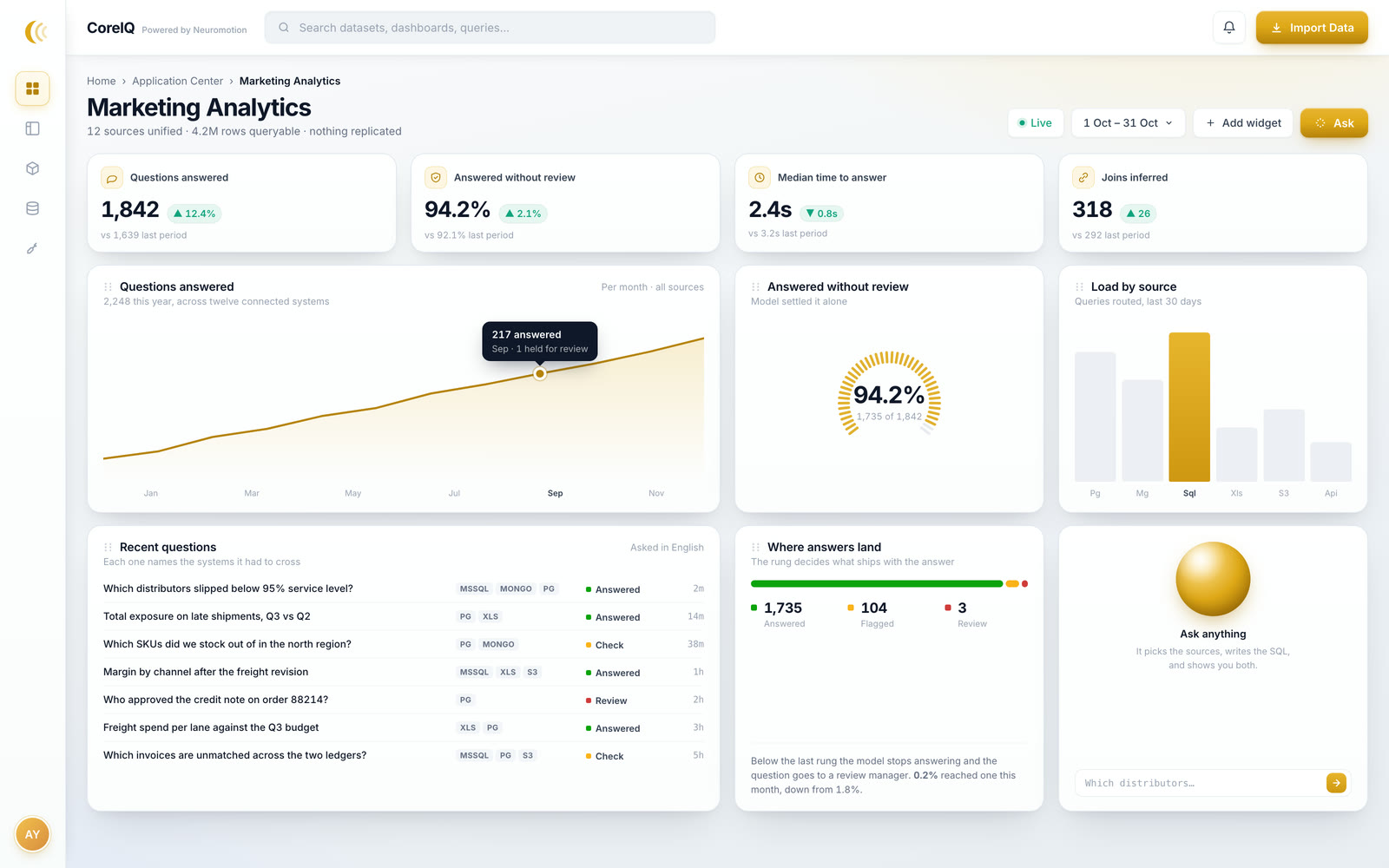
Datasets scoped to the person asking. A prompt begins by choosing a dataset, and the model works inside it — narrowing to the related table, then the column, then the row, before it answers.
Rejected, and why
Letting the model range over everything was the original plan and the easier product to explain. It lost on token cost at the data sizes this is built for. Scoping turned out to carry the access model too: a person queries what they have been given, not what exists.
Decision 03
A public LLM being wrong is an annoyance. An enterprise LLM being wrong about a number someone then acts on is a liability. The model could not answer in one register regardless of how sure it was.
Chosen
The answer changes shape with the model’s own confidence. Sure, and it answers. Slight doubt, and it answers but says to check. Lower, and the answer carries a badge and the reference it came from. Lower still, and a warning goes with it. Below that it does not answer yet — it re-runs its own process two or three times to see whether it converges. If it still cannot get there, the question escalates to a review manager, and the user sees it only after a person has approved it.
Rejected, and why
Our own model answering directly, the way a public one does, was the first intent and the thing the final design was built against. At enterprise stakes a confident wrong answer is worse than a held one, so uncertainty had to be visible on the answer itself and, past a threshold, had to stop being the model’s decision at all.
06 — The work
04 screens
desktopScreen name — what it does, and the decision it reflects
07
What happened
Knock-on effects
- The work shipped, and the product it became sells publicly at qwry.ai across power and distribution, manufacturing, supply chain, e-commerce and procurement
- The connect-and-unify flow I designed now carries forty-plus source integrations, from Postgres and MongoDB through spreadsheets, files and SaaS tools
- The spine of the product is still the path this design was built around — raw source to a verified answer you can check, with the SQL always in reach
08
In hindsight
What it taught me
- To research narrowly and precisely rather than broadly. The two findings that redirected this product were specific questions asked properly, not a survey of the field
- That designing a product in depth is a different craft from designing screens. What mattered here sat underneath the interface — what the system does when it is unsure, and who it turns to
- To go at the critical problem rather than around it. The file-explorer version was the comfortable design; the scale and access problem was the real one, and it had to be met head on
Next — 02